
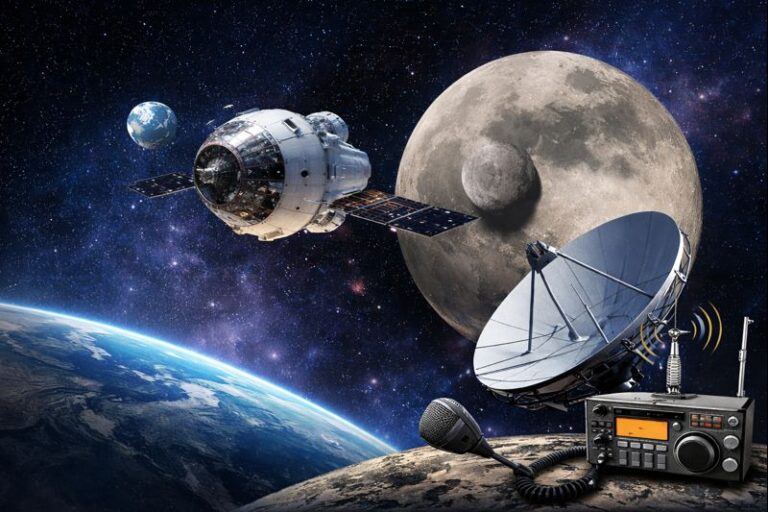
🛰️ NASA Invites Amateur Radio Volunteers to Support Artemis II Moon Mission
NASA is calling on the amateur radio community to help support a historic human spaceflight mission. As preparations continue for Artemis II, NASA is seeking qualified volunteer ground-station operators to assist with passive tracking of the Orion spacecraft during its crewed journey around the Moon in 2026.
Artemis II will be the first crewed mission of NASA’s Artemis program and will send astronauts beyond low Earth orbit for a lunar flyby before returning safely to Earth. While primary mission communications will be handled by NASA’s Deep Space Network, volunteer operators will help receive signals and provide observational data as part of a broader collaborative tracking effort.
According to the American Radio Relay League (ARRL), this opportunity builds on the successful participation of amateur and citizen science operators during Artemis I in 2022, where volunteer stations demonstrated the value of distributed, non-government ground tracking for deep-space missions.
📅 Registration Deadline: October 27, 2025
Amateur radio operators interested in supporting Artemis II must respond no later than October 27, 2025. Participation requires registration through SAM.gov, the official U.S. government System for Award Management.
All requirements, eligibility details, and participation instructions are outlined in the official ARRL announcement.
🔗 Important Links
- ARRL Full Article:
https://www.arrl.org/news/nasa-seeks-volunteers-to-help-track-artemis-ii-orion-spacecraft - Register via SAM.gov:
https://sam.gov
This is a rare opportunity for amateur radio operators to play a direct role in a historic crewed mission to the Moon. FFARA members with the interest and technical capability are encouraged to review the ARRL article carefully and submit their response well before the deadline.
Amateur radio continues to prove its importance—supporting exploration not just across the globe, but beyond it.